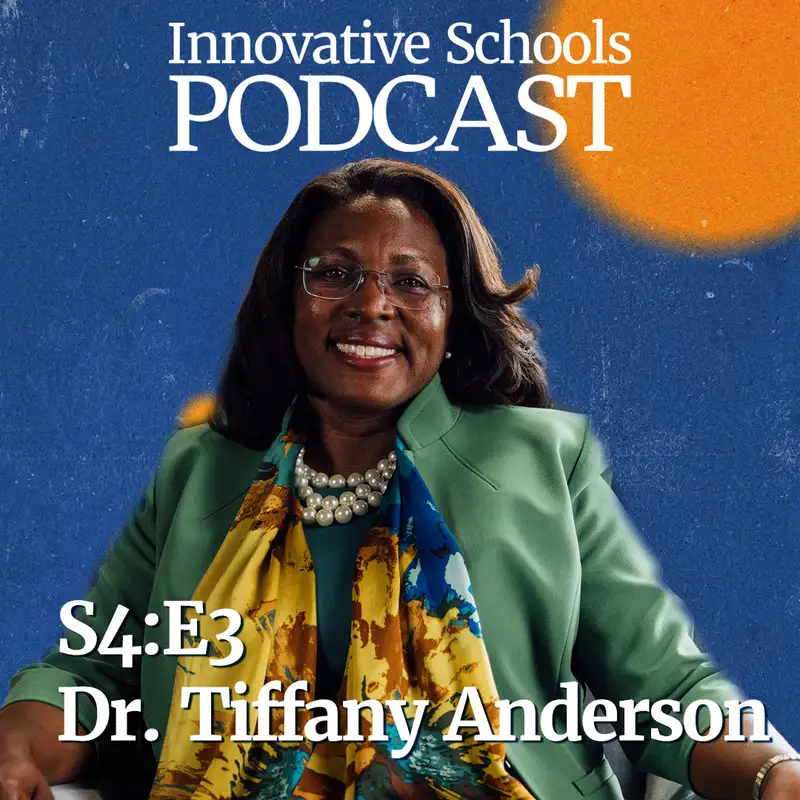
On this episode of the Innovative Schools Podcast, Kevin is sitting down with Doctor. Tiffany Anderson to talk about how networking and connections make education better. Come on, let's learn together.
Kevin:Welcome to the Innovative School Podcast. So grateful that you joined us today and have taken the time to watch this, to listen to it. If you're listening to it on one of our many areas that you can listen to our podcast or watch it on YouTube, thank you for being a part of this. Today, we have with us an incredible person, person who I've gotten to know over the past several years, who is making a difference in the lives of children and the lives of people. She practices what she preaches and talks about, been able to watch some of the things she's done, and she is lacing up her shoelaces and getting it done.
Kevin:And we're thrilled to have the one, the only Doctor. Tiffany Anderson with us today.
Dr. Tiffany Anderson:Thank you. Thank you so much for having me. Absolutely. The tennis shoes on and
Kevin:ready to All over, all over. To get started, who is Doctor. Tiffany Anderson?
Dr. Tiffany Anderson:Oh my goodness. The true definition is really I am a teacher. My title is different. It says superintendent, but I'm a teacher. We all have the opportunity to be a blessing and a lesson every day.
Dr. Tiffany Anderson:And I get a chance to teach and learn and use those to truly be a servant leader in the work that I do. It's not even really work. I tell everybody, Topeka is my mission field.
Kevin:That's right.
Dr. Tiffany Anderson:And truly, in that space, it's what makes your conference so amazing. The Innovative Summit is incredible because it really allows for people to see their service and their work as a mission So I get an opportunity to serve in an amazing mission field every day.
Kevin:How long have you have you been working in education?
Dr. Tiffany Anderson:Thirty years. Thirty years, twenty of which has been as a superintendent. Wow. It's been is pretty incredible.
Kevin:So I'm going to come back to the superintendency.
Dr. Tiffany Anderson:Yes.
Kevin:But why education? What got you started in education? What was the driving force behind that?
Dr. Tiffany Anderson:Yeah. I always knew that I wanted to be a teacher. I didn't know in what area. I knew pretty early on that serving others and doing it in a way that really changed lives was something that I knew I wanted to be part of. Didn't know exactly what it would look like.
Dr. Tiffany Anderson:And it's this piece of, I think, down, all of us have a purpose that we are to fulfill. What the name of the job is or what that looks like, we may not know. But I found myself enrolling in school, going straight into teaching. And four years later, I became a principal.
Kevin:Wow.
Dr. Tiffany Anderson:So I taught for four years. One year in St. Louis County in North County, and the other three years in a district that gets deseg students. So I was the only black teacher at a place called Kirkwood School District. Incredible experience.
Dr. Tiffany Anderson:You see, if you don't have a first, you'll never have a second. And that truly became pretty prophetic along the way in my career.
Kevin:So your first, chance at that school, what happened in that that began to change your your mentality, your your mind toward I'm making a difference, but there's more than I can do.
Dr. Tiffany Anderson:You know, it's pretty incredible. So after teaching, so I became a teacher in Kirkwood School District, and I had this idea. I wonder if we changed how we approached people, families and students. Could we close the achievement gap in record time? People say you can't do that.
Dr. Tiffany Anderson:That's just crazy. And there was a place called Meacham Park, which had predominantly African American families. It still does today. And so I invited these students. I wrote a grant.
Dr. Tiffany Anderson:A lady named Deborah Holmes funded it. Happened to be she was my elementary principal years ago. And she said, I think I know you. And it's amazing how things were just perfectly lined up. So Closing the Achievement Gap actually was the title of my very first book.
Dr. Tiffany Anderson:I became a principal in St. Louis City. And I talk about this when I share across the country a story that really changed my perspective about education and schools being the center of the community. One year early into my principal experience, I got a phone call. I can remember it like it was yesterday.
Dr. Tiffany Anderson:Two officers called and wanted to know, did all of our students show up? School was 99% African American, 100% free lunch. And very quickly, we looked through the building. And as this one teacher, Ellery Clark, fourth grade teacher, was on his way out the door to the art museum, our parent liaison said just a minute, he has one student that's absent. What we learned within about an hour was that Rodney McAllister, his fourth grade student, had died across the street from the school in the park.
Dr. Tiffany Anderson:He had been mauled to death by dogs overnight. Mauled to death And by so I knocked on doors and wanted to know from parents, didn't you hear screaming? And didn't you hear crying? And they said, well, of course, doc, we heard that. So I wanted to know why didn't you open the door?
Dr. Tiffany Anderson:And this is when the service that I provide that I'm privileged to give to any school changed. They didn't open the door out of fear. They didn't help one another, even if it's a child, the most vulnerable, out of fear for themselves, out of concern what would happen to them. And it's at that moment that the vision for how we serve people through school systems changed. So Rodney's mother didn't know that he was absent.
Dr. Tiffany Anderson:She was still asleep at home. She was a drug addict. So that year at Clark, began providing services for individuals who were addicts. We provided GED classes for families who didn't have their high school diploma. So they graduated with their fifth grade class.
Dr. Tiffany Anderson:Right after that, we had the high school graduation. We put washer and dryers in schools. We began really treating schools as a center of the community. And serving people well through our schools allowed us to literally transform the community. So it's something that we can still see today.
Dr. Tiffany Anderson:In Topeka, we do many of those things and far more. And we've seen the health map of our very own community change from at risk neighborhoods to becoming healthy and whole neighborhoods all through what the school system is doing. It's pretty incredible.
Kevin:I want to key in on on that a second. Causes his isn't the only story.
Dr. Tiffany Anderson:That's correct.
Kevin:There are stories all across the nation, and people are watching, people are listening. Perhaps they've heard a similar story. Maybe they've been a part of a story. What is it that you found teaching in that scenario, living in those areas that causes that fear? Why?
Kevin:What causes something to happen? And I'm just thinking about because sometimes that fear grips teachers.
Dr. Tiffany Anderson:Yes.
Kevin:In the classroom, that fear of, I don't know if I want to intervene. Don't know what is it that that causes that? Why do people respond in that way when deep down inside, I think we all want to help?
Dr. Tiffany Anderson:Yes, yes. You know, one of the things that's important to understand is that fear will shut a person down, will cause a person not to act, much like if you go down the street and you see something scary and you go the other way. And so it's so important to build trust within schools, trust within communities. And you can't build trust unless you're snickers to the ground.
Kevin:There you go.
Dr. Tiffany Anderson:You can't serve needs you don't know. And so it starts with finding out what those needs are and being vulnerable enough to go knock on a door and introduce yourself, to get to know the students beyond the classroom, to get to know families, and then to walk alongside them, to let them know they're not alone, and to teach them how to be better educators as well as the first educator a child will get is their parent. So all of this is really about how do we collectively impact the community and serve one another. When you're looking at life through the lens of it's all about just me, my job, my home, that's a very narrow lens. That is a lens that allows you only to impact you.
Dr. Tiffany Anderson:But you can actually function in any community unless the neighbors alongside you are also supporting the vision of the neighborhood. So I think fear comes from lack of understanding from others that are looking upon your neighborhood. Fear comes from just not connecting and having relationship. There are a lot of things that drive that. So in any community that I have the privilege to serve, we start with looking at the social determinants of health.
Dr. Tiffany Anderson:What does education look like? What does health look like? A lot of people will tell you schools aren't meant for that. I'll tell you the opposite. It's exactly why schools are there.
Dr. Tiffany Anderson:They are literally the center of the community. And you can change the community through one school and just imagine, through one school district and change generational poverty, create new systems that perhaps weren't there when you first started. I tell people this all the time. Programs come and go. They come and go with the leader in the budget, but systems, systems will remain and they will outlive you.
Dr. Tiffany Anderson:So a lot of this is really about disrupting the current system and creating new systems that serve people well.
Kevin:And systems without vision
Dr. Tiffany Anderson:Creates chaos.
Kevin:Yeah, exactly.
Dr. Tiffany Anderson:Truly. Because that's how you get systems that produce poverty, produce school to prison pipeline. Those are systems without vision. They are systems that will continue on and on year after year. We as educators, as community members, as parents, have to be fearless and disrupt that system and be prepared to re envision and re imagine what life could look like, truly have hope for a different future.
Dr. Tiffany Anderson:Every place that I've been, I've never come into a system where there are people that will say, Man, this is hopeless and I don't want my kids to do well. Every parent wants to see their child do well. Every teacher wants to see their students excel. And so really, if you give those tools about how do you serve people well, including the teachers that are within the systems that you're working or the principals or the parents that are in the community, if you give those tools, oh my goodness, people will not only latch on, but will be prepared to follow and become leaders in that same system.
Kevin:So what are because you're truly you really are a visionary person. You have gone into a lot of situations. You've been in three different areas superintendent. Correct?
Dr. Tiffany Anderson:Yeah. Three states. Yes.
Kevin:States as superintendent. And as you said, systems systems are there, and they've been there for a long time. But some of those systems didn't work because there wasn't a person there with a vision. And so talk to us about that. Talk to us about what drives you to have What is the vision that you've that you've brought in that said, hey, listen, I believe these systems can go, but we've got to make them happen.
Kevin:We've got to work together. And so talk to us about that.
Dr. Tiffany Anderson:Yes. Well, you know, it's so interesting. You know, a lot of times you'll go into a place and they'll say, we can't do this because of this. We can't do this because of parents. We can't do this because of money.
Dr. Tiffany Anderson:That's the main one. Can't do this because of that.
Kevin:No budget.
Dr. Tiffany Anderson:No budget. I've never gone into a place where they said, Man, we're overflowing with money. Often people will have all of the reasons, all the barriers of why something can't happen. And so I challenge that. I believe that there really are no true problems.
Dr. Tiffany Anderson:Everything is an opportunity uniquely designed for you. And if you look at life through that lens, that these are opportunities designed for you and you have the opportunity to walk through that and problem solve in a way that changes outcomes, That's a different kind of vision because it's one thing when you see something and you see a problem. And you and I can look at the same thing. And one person says, man, that's a problem community. That's a problem school district.
Dr. Tiffany Anderson:That's a failing place. But what I see is opportunity. I don't see problem. I say, no, that's an opportunity to bring more parents in. That's an opportunity to take a place that's at the bottom and they have no place to go but up.
Dr. Tiffany Anderson:That's an opportunity to get parents engaged in a way that transforms their whole community. So it starts with mindset. Vision doesn't just happen. It starts with how you think about why you're there, what's your why, how you think about the work that you have the privilege to do. It is a privilege to be an educator.
Dr. Tiffany Anderson:It's a privilege to be in a community where you get to serve every day and help produce outcomes that perhaps would be different if you weren't there. So requires a level of efficacy within our teachers and leaders. So when I speak across the country, I talk about them. How do they have balance? How do they look at the opportunities that are in front of them?
Dr. Tiffany Anderson:Do they see them as problems or do they see them as truly opportunities? Just waiting for them to come through the door.
Kevin:That's so good. All in all, your perspective.
Dr. Tiffany Anderson:Perspective, Perspective on
Kevin:things, wow, is all the difference, really.
Dr. Tiffany Anderson:It truly is.
Kevin:It's the difference between a successful area, successful place to work, a place that draws others in, a place that makes people want to stay and be a part.
Dr. Tiffany Anderson:Absolutely.
Kevin:Perspective has everything to do with it.
Dr. Tiffany Anderson:It really does. And with the right perspective, you can build trust in the community where people will follow you and will become leaders themselves. Sometimes I visit places where individuals, they're showing up, they have a great curriculum, but people don't like them or trust them. Well, I can tell you right now that that school is only going to go so far. That school district will not be able to progress in the way that they want because it does require trust.
Dr. Tiffany Anderson:See, we're hardwired to be connected. We really are. All people are. And all people want to feel a sense of belonging. And if you can create that, that's what unfortunately Rodney didn't have in St.
Dr. Tiffany Anderson:Louis, didn't have that community that had that sense of belonging. Because if they had that, they would have opened the door. They would have said, He belongs to me. He belongs to us. But when you can create a sense of belonging and trust that this is our work, this is our vision, boy, nothing can stop you.
Kevin:So how do you how do you do that? How do you go into a district that maybe it's not even a failing district?
Dr. Tiffany Anderson:Mhmm.
Kevin:But, man, you walk into the schools in the district and and none of them are together. Yeah. You've got one school that is is low. You've got one school that's really succeeding and high. But it seems like none of it's cohesive.
Kevin:None of them really want to work together and build community as a district, as a family. How do you do that? What did you do? Give us maybe People are listening. What are four four things, some concrete examples to help them?
Dr. Tiffany Anderson:Yeah, tell you, you know, it's amazing how silos work, which is what you just described, where people are in their own little area and they're only concerned about their area. I'll tell you, you know, there's research out of Harvard. And years ago when I was teaching, I came across it, and I've used it ever since. When I go into a district or a school or even a classroom, I look for these three things. It used to be called a tripod.
Dr. Tiffany Anderson:If someone looked that up and put Harvard, they'll find it. But it starts with relationships, number one. It's like there are three legs of a stool. So the first leg is relationships. And so when you walk into a system looking at relationships student to student, student to parent, student to the central office, all of that, staff to staff.
Dr. Tiffany Anderson:But if you don't have relationships and relationships built on trust, you will not be able to do the remaining two items. We just took our staff through crucial conversations. Just how do you talk to people and get accountability and build trust? We trained every department head. So imagine the custodian supervisor sitting there learning about how to talk to people.
Dr. Tiffany Anderson:And they deal with diversity at a whole another level. So everyone in the school district was trained, every principal, every assistant principal. That's an area that we don't invest enough time in. You don't just walk in knowing how do you build relationships. And it's more than just hello and good morning.
Dr. Tiffany Anderson:It's really true levels of trust. And that bleeds into the community. So that's one piece. Now one way that we do that, we have washer and dryers. Now in 18 of our schools, it started with Rodney.
Dr. Tiffany Anderson:When Rodney passed, we ended up putting washer and dryers in our school at Clark School, Clark Accelerated Academy. At the time, it was Clark School. It became Clark Accelerated Academy. And in one day, we might have had 50 parents washing clothes and that continued. And we realized we just created a new system.
Dr. Tiffany Anderson:If you can serve people right where they are, not only are you able to get families in, but you're also building trust because you're saying, I care about you. I know that you have some things that you need to get done. Let me make sure that I can provide that.
Kevin:And you did that because you recognized the need.
Dr. Tiffany Anderson:Recognized the needs. You can't serve needs you don't know. When I started in Jennings School District, that's in St. Louis, it borders Ferguson where the riots were. Everyone else's students walked out.
Dr. Tiffany Anderson:Ours didn't walk out. Why? Because they trusted us. When they wanted to walk out, I asked, well, what is it that you need and what is it that you want? So that became their homework assignment.
Dr. Tiffany Anderson:They came back the next day. They wanted body cameras. They wanted to see police officers that looked like them. That's not a bad list. They wanted community policing.
Dr. Tiffany Anderson:And so everyone dressed in their best suit. There pictures of it all over the nation. They took photos. They were flying cameras from news stations, looking at these students, looking like the civil rights movement marching up to the police station. Now we had to get back on time, so the bus took us halfway.
Dr. Tiffany Anderson:We marched up. Trust. Students trusted that something different was going to happen. So that's key. The other two areas are pedagogy and or you can call it systems of support and who's behind those systems, who's in the classroom, making sure you have the right folks that truly see the vision, the shared vision of serving people well.
Dr. Tiffany Anderson:That's an important piece. When we were in both when I was in Kansas City as well as in Jennings in St. Louis and started this as well in Topeka, where we started giving assessments, just a basic fifth grade assessment. If you want to teach fifth grade or sixth or seventh grade, we gave assessments at that level. You wouldn't believe how many teachers had a challenge with that level of assessment.
Dr. Tiffany Anderson:We had to coach them into maybe second grade or maybe third grade or maybe Spanish is the area that you need to be in. We had to really coach them into where they needed to land. But who's in that classroom? Who's leading that school? Pedagogy is everything.
Dr. Tiffany Anderson:And then that very last area, relationships, pedagogy, and an aligned standards based curriculum. But if you're not a person teaching in a school, again, systems of support and high expectations. We come in and we say, I expect all kids to learn, but I always ask to learn what? To learn how to do their ABCs and tie their shoes? Or do you expect them to learn at the highest levels of learning?
Dr. Tiffany Anderson:Do you expect every student to move two, three, four grade levels? We know it can happen. There are schools across the nation making it happen every day. So those three pieces are important. And they work together, you know?
Kevin:Just thinking, as you're saying that I think has something to do with it, Why why is it and part of this comes from me speaking with a principal in my area where I live and their frustration with what was happening in the school and some of the teachers that they're that they're working with, wanting to bottom line is they're teaching to the lowest standard instead of the highest standard.
Dr. Tiffany Anderson:How
Kevin:do we change that mindset to get to get teachers to say, listen, let's bring everybody up. But in order to do that, let's show them the ones that maybe come in with the lowest level, that they can achieve the highest level. So instead of teaching to the highest level, they're always teaching to the lowest level. How do we change that mindset within this?
Dr. Tiffany Anderson:It's funny you say that because that's rather common actually. Because of the diversity in a classroom, you have the highest level students, you have the lowest level students. So people normally teach either to the lowest level or to the middle. Rarely do they teach to the top. We began the year with teaching to the top.
Dr. Tiffany Anderson:Because how in the world are you going to raise everybody else up if you're not teaching to the top? We started something in Topeka. My second year there. Well, actually it was 2018. I started in 2016.
Dr. Tiffany Anderson:We were building a new innovation center. It's called TCALC, Topeka Center for Innovation. TCALC, as it was being built, asked the school board, can I take just one wing of the building and create a college prep program? And they said, who's going be the principal? I'll be the principal.
Dr. Tiffany Anderson:How are you going to be the superintendent and the It's possible. Just believe me, trust is possible. And they did trust that. How about I take the lowest performing students, the highest poverty students in the school district, this is a district of 13,000. We took the highest poverty, 25 students from East Topeka, a school named Chase School that were the farthest behind, two, three grade levels behind middle school students.
Dr. Tiffany Anderson:We entered them into the College Prep Academy. And those students not only excelled three, four grade levels above, every student since then this is my tenth year has moved through the middle school, through the high school, and into college, and many So into graduate we actually have a person that follows them all the way through life.
Kevin:Amazing.
Dr. Tiffany Anderson:So we're keeping track of all of those students. I'm still the principal, while still superintendent in Topeka. Still the principal of College Prep Academy. They're the one space where they wear uniforms. Very interesting to see when you bring students that are far behind, perhaps anyone, and you give them hope for a future that's beyond where they may have seen themselves.
Dr. Tiffany Anderson:You let them know that you believe in it so much that you're going to invest your time and effort and energy and your resources into making it happen just because it's them, because they deserve it. That was a game changer for the families, for the students. About a year ago, I actually taught middle school in that same space.
Kevin:Same school.
Dr. Tiffany Anderson:Sure, same school. So I have a superintendent, the principal, and a teacher for a semester. Oh, man, teaching middle school nowadays. Bless those teachers Have in middle mercy. And I tell you what, I left that experience and we made some additional changes.
Dr. Tiffany Anderson:We tweaked our curriculum. We made some adjustments. There are some things that I had to ask. Now why do we do it this way? How much grammar are we actually teaching in our English courses?
Dr. Tiffany Anderson:So we further tweak. Again, you can't serve needs you don't know. So I continue to learn along the way, in this space. And again, I'm privileged to learn from the incredible educators in Topeka and any other place that I've been.
Kevin:But you, here's what I think. You can correct me if I'm wrong.
Dr. Tiffany Anderson:Yes.
Kevin:I think that change came because you gave students hope to believe in themselves that they could accomplish what they were born to accomplish. Yes. Instead of bringing them down to the level to say, I'm not sure you can really do that because everybody else has said you couldn't do that. And so we continue to teach you like you can't do it because five people that had you when you were in kindergarten thought you couldn't do it either.
Dr. Tiffany Anderson:Absolutely. Absolutely. And so here's the thing. And this is what I love about the Innovative Summit, because you bring speakers and other educators from around the world to one place to talk about what's possible. Years ago, you have Ron Clark Academy educators here.
Dr. Tiffany Anderson:Years ago, I've taken educators in multiple states to Ron Clark Academy. That's really where the College Prep Academy was born out of, actually. We saw the Ron Clark Academy and said, I think we can do that. I know we can do that. In fact, the challenge, the opportunity is before us uniquely designed for us.
Dr. Tiffany Anderson:Who would have known there'd be a building that was being built that year in Topeka? And we can call it College Prep Academy and the rest is history. So you're not in this alone. There are places like Topeka all over the nation and places like the Innovative Summit. What you've created here is really a collaborative space for leaders to come and get a chance to plan and learn and learn from one another and then replicate it, build from that.
Dr. Tiffany Anderson:We are not in this alone. Collectively, we can do far more than you can ever do by yourself.
Kevin:And and I appreciate I appreciate you saying that. I appreciate the thought that because I've seen you've seen it, the the idea that and it bleeds into a whole another subject. We won't get into it. But so many people look at look at the wrong car. We go there and instead of thinking to themselves, hey, I can do that.
Kevin:I've got the ability to do that. We can do that back where we are. All of a sudden, jealousy kicks in because, oh, well, they've got sponsorships. They got all this. And all the jealousy kicks in instead of celebrating what someone was able to do and think, man, that's incredible what they're doing.
Kevin:I'm going to go back and do that as well because I've got the ability to do that and I believe our people have the ability to do that. So thank you for doing that. Thank you for believing in not only your abilities, but the people who you serve and who are a part of your family have the ability to do.
Dr. Tiffany Anderson:No, you for bringing these people together. So you know, when we send staff here, because the Innovative Summit is unique in that you have multiple conferences all in one space, so you can hit multiple things in one time. You know, I tell our staff when they come, you better come back with at least 10 contacts, 10 contacts of people who are doing things better than we're doing, who are doing things different than what we're doing, who are creating systems that we can learn from. That's the beautiful part. You'll learn a lot that you can take back to your own space, But you'll network in a place with people across the country.
Dr. Tiffany Anderson:I think this conference, have 48 states represented. 48 states. You'll network with people from all over that you can really learn from. Here's the thing that I tell people, you need to listen to learn. Stop listening to respond all the time and to be the smartest person in the room.
Dr. Tiffany Anderson:Exactly. All of us, we're placed in these spaces alongside other people and we're able to take a breath and energy with these folks so that we truly can be learners and listen to learn. And from that, create new systems and new ways in which to serve families and students and community members who are literally depending on us. You know, when I started in Topeka, before I started on my first day, July 2016, I came a few months earlier and I started visiting churches. And cancer of needs you don't know.
Dr. Tiffany Anderson:So the history of Topeka, it's where the Brown v. Board legislation occurred. So all of the schools now that are integrated are because of Topeka. It's an incredible place. So the first church was St.
Dr. Tiffany Anderson:Mark's AME. Linda Brown from the Brown v Board Case was on the organ playing.
Kevin:Oh, wow.
Dr. Tiffany Anderson:And someone said, that's Linda. I said, Linda who? They said, Linda Brown, the Linda Brown that you've read about in the history books. After she got off the organ at the end of church service, I just asked, could I take a picture of her and with her? And then she said, I've been waiting a long time for you.
Dr. Tiffany Anderson:I've been waiting over fifty years for you. We expect, we expect great things. She's letting me know right there, the expectation for families who now have the first black female superintendent in Topeka, Kansas, where the Brown v Board case was. They expect great things. So the bar was set right there.
Dr. Tiffany Anderson:Imagine to your other question if she started with saying, I hope you can do enough to help us get by, that bar be so far on the floor that it wouldn't be a lot for me to be reaching for. But with that one statement, I thought, oh man, I better get some new tennis shoes because we're going be running here. We got a lot to do.
Kevin:And for those of you who are not watching this, that you're listening to the podcast, Doctor. Andersen always wears these white tennis shoes laced up and ready to roll everywhere she goes. So you're not being able to see that,
Kevin:but she's got them on right now. She wears them everywhere.
Kevin:You go on, it's a sixty minute on most any of the interviews she's done on TV and the specials they've done about her, she'll have the white shoes on. You can go see it.
Dr. Tiffany Anderson:You know, I've been wearing tennis shoes since I was a teacher. A teacher, I showed up in a suit and tennis shoes. And as a classroom teacher and I'm still a teacher today
Kevin:Have you gotten a tennis shoe sponsor yet? You need one. Actually need
Dr. Tiffany Anderson:did have one. When I worked in Kansas City at University Academy, yes, since Socone, Saucony, had never even heard of the shoe. They asked could they be this I actually had a tennis shoe sponsor during those few years.
Kevin:Is Anybody watching? If you want to be a sponsor, she's waiting for another one.
Dr. Tiffany Anderson:I'm wearing hocus, but I wear
Kevin:whatever You you gotta go. Come on, let's get her a sponsorship.
Dr. Tiffany Anderson:This whole piece of, you know, figuratively and literally, shoes to the ground, boots, sneakers to the ground and making sure that you're spending more time in the community, meeting people, serving people than you are in any office.
Kevin:Get out from behind the desk.
Dr. Tiffany Anderson:Than you are behind any Yes. It's it's a privilege to serve and it's it's why we're here.
Kevin:You use that word a lot. And I know because I've gotten the chance to know you and get talk with you and I understand why you use that word. Why do you share? Why is that word so important? Why does that come up in a lot of your conversation, the word serve?
Dr. Tiffany Anderson:Yeah. Well, me personally, my faith is a strong part of who I am. There's a scripture in the Bible in the book of John, chapter 15, and it says, God's greatest command is if love one another as I have loved you. Love one another. So when you think about what does that look like?
Dr. Tiffany Anderson:What does love in action look like? Well, love in action is making sure that young people have meals to eat when they're coming to school and when they go home that they have something to take with them. Love and action looks like washing dryers in schools. Love and action looks like when you hear someone crying or seeing someone laying on the street that you are literally the Good Samaritan and you're opening your door and you're reaching out a hand. Because if you don't, what will happen to the community?
Dr. Tiffany Anderson:Not just them, but you. So serving others well, service above self, I believe, is why we are all here. Doctor. King has a quote that he often says in several of his sermons. There's a great book, think I it's called A Knock at Midnight, and it has a collection of all of his sermons.
Dr. Tiffany Anderson:So a lot of times when I drive to Topeka, I listen to his sermons every day. And he often says this quote. It's from John Dunn from The Bell Toll. And it says, I can only do well if you do well, and you can only do well if I do well because we are all connected. We're part of the main.
Dr. Tiffany Anderson:For whom the bell tolls, the bell tolls for me. You know, it's this idea that we are all literally connected. The sooner we realize that, the sooner we will be able to move mountains and transform communities in ways beyond we could have ever imagined. I think the reason that some communities are at a standstill is because of the divisiveness, because they're divided. I think some communities are at a standstill because they don't quite realize that because although we look different, we are actually the same and we're connected in a way that movement can only happen if we work together.
Dr. Tiffany Anderson:That's why those silos have to be broken down. And educators, I think, have the tools to do that, whether you're a superintendent or you're a principal or you're a parent. At the end of the day, you're a teacher.
Kevin:You're a
Dr. Tiffany Anderson:blessing and a lesson. Everybody that's around you watching you.
Kevin:Like that a blessing and a lesson. You're a blessing
Dr. Tiffany Anderson:and a lesson. We were right here in Nashville, so we know we need to have that southern twang, truly. And I believe that when people realize that, that they're connected to one another, it can change everything that they do Because you know, you'd see life through other people's shoes and you get to walk in their shoes.
Kevin:For too long, we've tried to see it through our eyes.
Dr. Tiffany Anderson:Yes, yes.
Kevin:Instead of trying to start seeing life through other people's eyes and how they see things
Dr. Tiffany Anderson:and recognizing
Kevin:that we're in this together, but sometimes the pain and the hurt is a lot different than what you've experienced.
Dr. Tiffany Anderson:Oh, absolutely. Absolutely. One of the pieces that I'll show and I share in the keynotes that I do is a small clip of a student's life. There was a cable series. Can you imagine 12 episodes of following us around like reality TV?
Dr. Tiffany Anderson:And they were so fascinated at, you know, what do schools actually look like today and how do you begin to transform them? So my second year in Topeka, A and E, a cable TV show, approached our school board. They agreed to do it as long as they established a scholarship for the district for these students. And so there was the news station every day when I woke up from when you go to sleep planted in this high poverty school that had high mobility in East Topeka. And they wanted to look at the lives of students.
Dr. Tiffany Anderson:And what we learned are truly some insights into what students are taking home, what happens at home when they get there that we could never imagine was happening when they come through the door. The student that loses their cool in class that we might discipline in a punitive way, perhaps that outburst is for something well beyond the school doors that we need to understand. That show really transformed how some teachers looked at some of the lives of their children and the community. And one of the things we do in Topeka, we have listening tours. In fact, I'll be doing one next week.
Dr. Tiffany Anderson:I'm at the grocery store bagging groceries. And you're in Topeka, just come on down, can bag groceries.
Kevin:What store are gonna be at?
Dr. Tiffany Anderson:You know what? I'll be at Dylan's. Oh, Okay. So Dylan's in Topeka bag
Kevin:Come on down to Dylan's. Get your peanut butter and peggers.
Dr. Tiffany Anderson:That's That's right. And, and at Dylan's, which is I think in this area it's called Kroger, the Dylan's trademark. And at Dylan's, I get to serve groceries. I get to bag groceries. Wow.
Dr. Tiffany Anderson:People will talk different to you when you meet them where they So picking up someone's watermelon and eggs and bread and saying what's going on in the community. What happened down on 4th Street? What are some fears you have before school starts? You learn a little bit about items that are happening in the community you wouldn't learn otherwise. You learn about families who were maybe hesitant to send their children to school because they didn't have new clothes or they didn't have clothes at all.
Dr. Tiffany Anderson:You learn about homelessness. It's been incredible. Topeka, we had 600 homeless students when I started. I've never been in a district that picked up homeless students from with school buses from the shelter. We now have two fifty.
Dr. Tiffany Anderson:We reduced homelessness by over 50%.
Kevin:Amazing.
Dr. Tiffany Anderson:Because we work together and we're one united team with the businesses, with the landlords, with our educators, and we literally transform the community and change the footprint of Topeka, Kansas. Pretty incredible stuff.
Kevin:That is. That's amazing stuff.
Dr. Tiffany Anderson:Topeka's an amazing place. But any city can do what we've done and And replicate
Kevin:you just I wanted to shout this out to you because you became you just got National Superintendent of the year?
Dr. Tiffany Anderson:Yes.
Kevin:Yes. Or national female superintendent of the year? That was the award you just got this past this past year, right?
Dr. Tiffany Anderson:About a year ago. Yes.
Kevin:Amazing. So, a shout out to you for doing that.
Dr. Tiffany Anderson:Oh, thank you.
Kevin:I could sit here and talk to you all day, and I'm trying to watch our time as well. And I've got just a couple more questions. But before I ask you the last set of questions, my rapid fire, whatever, is speak to the superintendent because that's what your role is right now. Speak to the superintendent, the administrative leader, perhaps, maybe it's a principal at the school. Give them three or four steps to the frustrated one, one that's listening that's frustrated.
Kevin:They're frustrated with their job. They're frustrated with the things that are going on. They're getting ready to walk back into school in the next week, in the next two weeks. Teachers are coming back, students are coming back, and they're already frustrated before they even come back. Give some encouragement to them.
Dr. Tiffany Anderson:Yeah, absolutely. All right, should I look at you or should I look at that camera right there?
Kevin:Whichever you wanted, look at the camera.
Dr. Tiffany Anderson:Look at the camera. I'm gonna look at that camera. That's right. You been do there. Absolutely.
Dr. Tiffany Anderson:Well, if you're a superintendent who is new, if you're a teacher or principal, if you're a leader in the community and you're new and you're frustrated and you feel like people don't understand you, the first thing I want you to know is you were there on purpose. You every challenge, everything that someone calls a problem is an opportunity just designed for you. It actually is. And your perspective and your mindset is everything that's needed for the opportunities that you'll have. You're enough and you're not alone.
Dr. Tiffany Anderson:So just by virtue of virtually, I am now not only your ally and your advocate, but you have a whole lot of other folks waiting to pour into you and the students that are entrusted to you. Here's the thing, if you don't do it, if you aren't the person to transform the community, then who will? I thank you for leading and selecting to be the leader in the place that you're serving. You're going to have an amazing year. That's to every leader, whether you're leading in the classroom, whether you're leading as a principal or a superintendent.
Dr. Tiffany Anderson:In this space where we get to serve the most vulnerable, we are entrusted to and I do say servants a lot, but to be servant leaders guiding people to new places of hope. We are literally ambassadors of hope. And I am excited to meet all of those other ambassadors at this conference. And for those that are watching this podcast, I always tell people if they email or call, I will return that email or call. I actually do.
Dr. Tiffany Anderson:Oh my goodness, after the last conference, there may have been about two or 300. It took me a minute. I had coffee with a few people actually. Visually. And so, you know, we are all connected in this work of how do you serve the most vulnerable.
Dr. Tiffany Anderson:Our states, our country, they're counting on it.
Kevin:Give them hope.
Dr. Tiffany Anderson:Absolutely. Be an ambassador of hope.
Kevin:So question number one. This may be a little tough, maybe it's not tough, maybe for you it will be easy. But if you could go back and you think back over all your career, the thirty years, what's something that you look back now and say I would do differently?
Dr. Tiffany Anderson:Well, know, first of all, I am so blessed in that a lot of the work that I've had the opportunity to do, most of it really has been as a principal or superintendent. Most people don't start in this work after four years in teaching. But if I had to do something different, far sooner would I wish I knew then what I know now because as a first year teacher, the first thing that I would have done would have been to build relationships in the community in a way that showed possibility. As a new teacher, you follow the lead of the principal and you kind of try to do as you're told and to make things work. I bet there are lot of teachers listening right now in that same space.
Dr. Tiffany Anderson:I know now that the opportunities were designed for you. That gives you tremendous freedom. I know now that those families that are waiting for you to knock at their door or to say, man, how can I walk alongside you or serve at the shelter in the morning before you go to school so you get a chance to see your families in another space, I know now that those opportunities are right there waiting? Oh my, I wish as a first year teacher I realized that. And I jumped right into being part of this transformational work that I've now had the privilege to be a part of for the last thirty years, twenty of which as superintendent.
Dr. Tiffany Anderson:But just imagine that very first year, you know, we get a chance to impact lives. And at the end of that year, that year is gone. So what you do every moment of every day, it matters. It's an investment of time.
Kevin:Who's been the one person that has in your role in education, who's been the teacher or the other principal, the other superintendent? Who's been that one person that changed who you are as a person the most?
Dr. Tiffany Anderson:Okay. Now, somehow I'm gonna bring up my husband in this thing. You know? Somehow He's not a principal. He's not a superintendent.
Dr. Tiffany Anderson:But, man, he is my best teacher. No doubt about that. Now, first, I will tell you that a lot of teachers, my teacher, Ms. Green, who I still write to today, she actually is on a memory facility and, I still visit her every fifth grade teacher. So those elementary teachers, these adults will remember you and the impact.
Dr. Tiffany Anderson:I remember a number of teachers and superintendents. My superintendent Doctor. Cleveland Hammonds in St. Louis As a first year principal, I remember when other people said, well, she's only 25. She's the youngest principal in the state of Missouri.
Dr. Tiffany Anderson:We've been teaching longer than she's been alive. This young lady can't do this. And he allowed me to remain. He supported me with the changes. He was fearless.
Dr. Tiffany Anderson:So superintendents, support your young principals, support your young leaders, and give them what they need to be able to succeed and excel. If it had not been for him, perhaps I would not have the career that I have now. So the late Cleveland Hammonds is amazing. But my husband, Doctor. Stanley Anderson, he passed in 2017 from multiple myeloma.
Dr. Tiffany Anderson:What he taught me as a physician who also volunteered at a place called Swope Clinic providing OBGYN services at no cost. He's one of the only male African American OBGYN chairs in Kansas City. Introduced robotic surgery to Kansas City. So if you're a woman getting hysterectomy now, it's just a pinprick. All because of Doctor.
Dr. Tiffany Anderson:Stanley Anderson and a team of other physicians who could see life different and hope different. I was so fascinated when I met him in college and wanted to know how did he get to St. Louis University. He said one teacher, Ann Suter, who saw him in school and he was in poverty at the time. She said, You've been overlooked and I'm gonna change that relationship connection.
Dr. Tiffany Anderson:And because of Ann Suter, he became the school valedictorian. Perhaps it was a salutatorian. He became the top of his class and applied to one college, St. Louis University, got a full ride scholarship, and the rest is history. Smartest man that I'll know.
Dr. Tiffany Anderson:Bible scholar, history scholar and a physician. So in our service together, what we learn from one another is that we are here on purpose to serve. So as he transitioned, I call it his new life, on our wedding anniversary, his new life date, it's actually a few weeks from now actually, right here in Tennessee. So I'll be back here in a few weeks visiting the space in which he was laid to rest. As he started his new life, he said to me then, and I still carry this with me now, our life and purpose has been to serve, serve well, serve our children well and serve those that are counting on us well.
Dr. Tiffany Anderson:So I continue to live out that scripture. My greatest command is this, to love one another as I have loved you. And my prayer is that I live that out in a way that God is pleased with. And I am committed to making sure that because of some small part that I played, life for others is different.
Kevin:And it is. Yeah. That's eight.
Dr. Tiffany Anderson:Yeah. Good stuff.
Kevin:It is.
Dr. Tiffany Anderson:I love being here. Man. Thank you for being We could talk all day.
Kevin:I could. I could. There's that's there's so much just in that last little bit. But yeah, thank you. Thank you for doing that.
Kevin:Last question for you. At what point, because obviously, four years and then you become principal. So you've been doing leadership a long time. Mhmm. What point in your life did you realize you were a leader?
Dr. Tiffany Anderson:Oh, my word.
Kevin:Something in school, something when you were a little kid.
Dr. Tiffany Anderson:You know what? What happened that So my parents, are retired pastors. And, perhaps the blessing and the lesson, comes from that in that you were born to serve and to lead and all of us can lead by being And that's what they've instilled in me. And so I knew I was a quiet child. Was a quiet obedient child.
Dr. Tiffany Anderson:I know it's hard to believe now. It's quiet. But they instilled in me that there's a quiet leadership as well in serving. And so very early on, I served meals for the homeless and all those other pieces. And so I knew then, I didn't know in what shape.
Dr. Tiffany Anderson:I also knew that I would be a teacher in some way. I didn't know how or when or where and what God would put in place for me to walk through and into. But the lesson in that is that we all have the ability to pour into young people and to pour into others. You know, it's really interesting. Right before we start talking, I met this young man who works for you.
Dr. Tiffany Anderson:I think his name is Will. I said, How did you know about this job? Know, one, I'm always recruiting for teachers. Was going take your person. And the other piece is, I just like to hear their story.
Dr. Tiffany Anderson:He said at church, he knew someone that's already connected to you or perhaps in your family, but at church, he met someone who knew someone and he said, it's a real interesting group because everyone, he said, within the Innovative Summit team are connected in some way, whether it's church or friends or but that connection is so strong that he couldn't see himself being anywhere else. Now that's deep.
Kevin:So
Dr. Tiffany Anderson:we all have the ability to pour into other people. Someone through the summit poured into this young man who is now even pouring into me, sharing with me how because of that, it changed his life and he gets a chance to impact others in these large ways.
Kevin:I think that person was Jordan who
Dr. Tiffany Anderson:Was it Jordan? Okay. Who
Kevin:we're looking out across now.
Dr. Tiffany Anderson:It was Jordan, yes.
Kevin:On the other side of the camera. But Jordan, who's done an incredible job facilitating a lot of those connections and does a great job with that.
Dr. Tiffany Anderson:I mean, it's pretty incredible. So when you get a chance to see people, important to people and tell them that you're meant to lead do that. Sometimes people have these voices in their head that they can't do it or it's too big for them. Thank goodness for Ms. Green in fifth grade Thank for goodness for Cleveland Hammonds who saw something in me as a principal.
Dr. Tiffany Anderson:And so we all have the opportunity to help develop the capacity of future leaders.
Kevin:That's good. We all need someone that believes in us. Yes. And so thank you. Thank you for being here.
Kevin:Thanks for hanging out with me and chatting. And You know, one thing, I will share this because no one may Well, people know you know this, I'm sure, Mhmm. But Doctor. Anderson loves some good barbecue sauce. White shoes and barbecue sauce.
Kevin:So let let's just if if you wanna send her some send her your favorite barbecue sauce, let her try it because she's got hers. She brought me some. And I want to try it. I want to try it. Ain't got to try it.
Dr. Tiffany Anderson:Gates Barbecue from Kansas City, baby. You sure do have some barbecue sauce.
Kevin:But, no, thank you for being here. You're an amazing person, truly are. Thank you. Thank you for seeing the best in people. And for those of you that are watching, thanks for joining the Innovative Schools Podcast.
Kevin:And we just want you to know, truly, we believe in you. We do what we do because we believe in everybody that comes to our summits that watch this podcast, that you're an amazing person. You'll do something great. Believe in your kids, and you'll see lives transformed. So, thanks, and we'll see you next time.