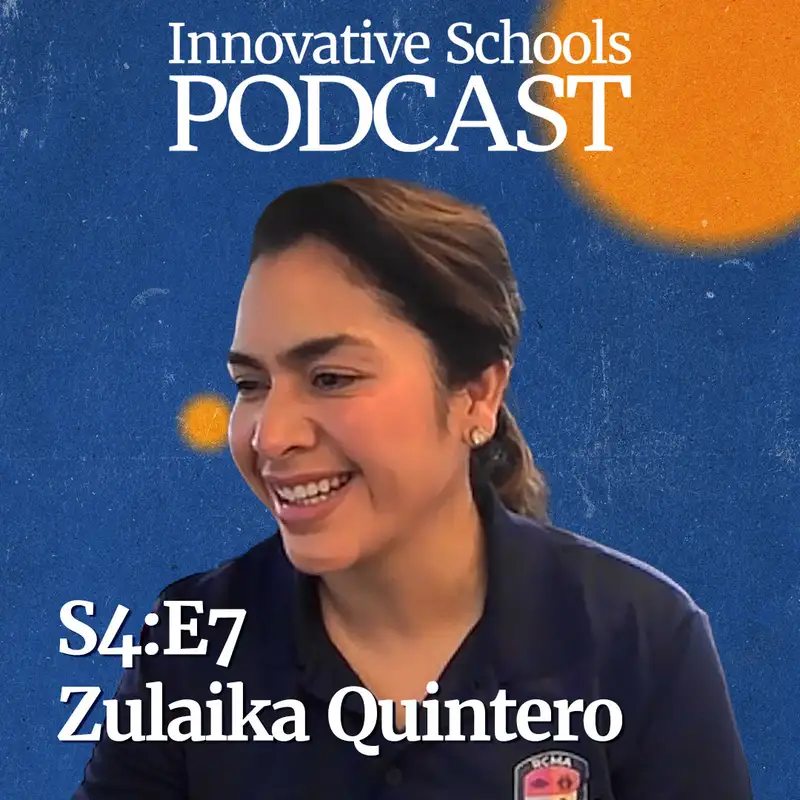
On this episode of the Innovative Schools Podcast, we're sitting down with the principal of a Florida school who empowered her team to take it from a d rating to an a rating. Come on. Let's learn together. Hey, listeners. It's Jordan, Innovative Schools Podcast.
Jordan:I'm so glad that you could join us on this episode. Today, we're doing something kind of a little bit different. We have someone who is in a school, someone who has put in the hard work, someone who has poured in the blood, sweat, and tears, someone who's currently still active in their school, making improvements, finding innovative strategies and things to improve her school. And someone we haven't had on before, this is someone who has a relation to someone that we've had on before. But it's someone who...
Jordan:When we heard their story, we said we need to get this and we need to help spread this great story to people to help them potentially find new ways to help the students and the kids in their schools and in their classrooms. So I wanna kinda just get into this and for us to just start talking to this person. So I want to introduce you to Zulaika. Hi, Zulaika. How are you doing today?
Zulaika Quintero:Hi, Jordan. I'm doing well. Thank you for having me today.
Jordan:Yeah. I love that you're doing this from your school too. Like, you're there. If you're one of our audio listeners, she is sitting, I'm assuming in her office, right here promoting her school behind her. She's got the the shirt on, right, with the with the crest or, you know, logo or whatever.
Jordan:But she's like in her school. She's not just like even taking a break from working at her school to do this podcast with us. So I I just love that. I love that so much.
Zulaika Quintero:I mean, I did put a DND on my phone and I turned off my walkie and I put a DND on my, front office. That way, you know, we're able to to be here and actually be able to spend some time with you, on this podcast. But if any case anyone pops in, you know it's an emergency.
Jordan:Yes. Yes. So, you just let us know how long you want this to take if you need a longer break from the ins and outs of school or whatever. We can make this last as long as you want for those do not disturbs to to stay on as long as possible. You just you just let us pull on your ear or something and let us know, like, keep going, something like that.
Jordan:But Zulaika, I want to take a minute to just back up and and talk about you for a minute. And let's kinda start with where where you are, what school are you in, what's your role, and just tell us a little bit about that kind of area.
Zulaika Quintero:Sure. So I'm currently still serving in Immokalee, Florida. Immokalee is located in the Southwest Area of Florida, near Naples and Fort Myers. We're a pretty rural community here in Immokalee. Majority of our families that we do serve are farmworker families who continue to work the crops and get to pick the vegetables and fruits that we get to enjoy on a daily basis, Jordan.
Zulaika Quintero:Our school consisted of, about three fifty students here, and we get to serve them from August to May and then over summer for seven weeks. So it's a nonstop school. I feel like we're never closed. And it's because of where we're located, our community and our community needs. Our community doesn't stop.
Zulaika Quintero:They continue to work. So it makes sense that we get to support our families as we're here. But I mean, right talking about our community, I mean, right outside, we have, you know, our chickens running around. Oh, really? Yeah, it's very unique.
Zulaika Quintero:So if you hear some chickens in the background, you know why. Again, it's it's a very. I would say, close knit community here in Immokalee. We are one, the only public charter school here. Majority of the others or all the others are elementary, and we have about five elementary schools.
Zulaika Quintero:We have one middle school and one high school here in our Gotcha.
Jordan:So you're a public charter school and what grades do you serve at your school?
Zulaika Quintero:We serve kindergarten to eighth grade. However, our school is kind of part of the umbrella of an organization that is called Redlands Christian Migrant Association. Acronym is RCMA. And RCMA has three charter schools. But before charter schools came along, they were early childcare providers, and they still provide early childcare to our kids from rural communities in Florida.
Zulaika Quintero:In Immokalee alone, they serve students and families from six weeks old to pre K. Then what happens is we as our charter school system, we get to then take in those pre K scholars into our campus. And many of them stay and are with us from since they're babies up until now eighth grade. This is our fourth year with seventh and eighth grade. So we will get to graduate our fourth graduating eighth grade class this school year.
Jordan:Wow. That's awesome.
Zulaika Quintero:Yeah. It's pretty neat. I... That that was a vision of of, of mine is, you know, serving K eighth because again, we only have one middle school and one high school. And I always believe that middle school can be a challenging era in our lives.
Zulaika Quintero:Right? You decide.
Jordan:Yeah. I remember that. Middle school. Oh gosh. Not a time I wanna go back to.
Jordan:Bless those middle school teachers though. Bless their hearts. I mean, just they put in the real work. They really do. Mhmm.
Zulaika Quintero:They do. They... They're wonderful, though. Again, we have had our students from many... Since kindergarten.
Zulaika Quintero:So we get to know the families. We get to know more than just our students, right? So I think that helps also have an environment where we're like a big family. That, you know, it's not isn't perfect, but we do end up kind of seeing each other as a big family to support all of our our friends that we get to have on our campus.
Jordan:Yeah. This sounds like such a cool and unique situation. So far, we've covered chickens outside Mhmm. Taking care of kids as young as six weeks old through the parent organization, you being a k through eighth grade, just a completely unique and interesting education situation. And you kept mentioning about being a family.
Jordan:Earlier when I was talking to you, you talked about Immokalee and what it means. Could you tell us what is... What does that mean?
Zulaika Quintero:Immokalee. Immokalee has a seminal reservation as well. So again, we're very unique because we have a ton of different backgrounds, heritages. And Immokalee actually stands for my home in Native American. And again, a lot of people who were raised here, born here, I feel like there's a sense of pride, I guess, and goes back to the meaning of our community.
Jordan:Mhmm. Yeah. I love that and and all that. So let's let's get a little bit into kinda why we're talking to you. I love that we've talked about kinda...
Jordan:We've gotten that foundation of the community and the school and a little bit about you. But the reason why... The the part of what you're doing there, what kind of interested me and and the team here at the podcast was that you came in in '20... Let's see, 2016. I had to check my notes.
Jordan:You came into that school as the the principal in 2016. You were working there prior, but then moved up into the principal role. Right? That's correct?
Zulaika Quintero:Correct.
Jordan:Yeah. And at that time, Amakali was rated as a d school.
Zulaika Quintero:Amakali Community School was rated as a d school. Mhmm. Mhmm.
Jordan:And what is... Is that the lowest grade or is there one below that? I mean, there's For Florida or for how you guys are graded?
Zulaika Quintero:Yeah. Florida does the a through f ranking. Right?
Jordan:Got them. Okay.
Zulaika Quintero:So we weren't the lowest of the totem pole, but we were we were close. We were close. Right.
Jordan:And since then, though, as of the twenty twenty three, twenty four school year, you are now an a rated school. So over a handful of years, maybe a little bit more, that school has been able to be transformed from a lower performing school to... Of d up into an a. And that was... First of all, just congratulations on Thank you.
Jordan:Doing that. That is such a testament of your servant heart, your servitude to the community and to the school and to the kids that are... The students that are there. But, you know, when you hear stories like that, you you kinda... Especially in the circle of education, you start to think, okay, what did they do?
Jordan:What happened? What what was going on? So I wanna walk through that story and hear from your perspective kind of the way things worked out. And if we can provide our listeners with a little bit of insight of maybe things to to help them or motivation or encouragement or any of those different things. And so that's kind of my plan for today for this episode is for us to walk through that story and talk about that.
Jordan:So let's just start at the beginning. You come in as the principal
Zulaika Quintero:Mhmm.
Jordan:Of this school that needs some help. When you came in as principal, what is... What was it like? What was going on? What were things that you identified as things that needed to kinda be addressed?
Jordan:Let's just kinda paint the picture first of where the school was back in 2016.
Zulaika Quintero:Well, I think now... I mean, that was about ten years ago. I am going into my eleventh year now as our school principal. But, I mean, ten years ago, there's it was very different, obviously, than now. There was a lot of things that we had to work on.
Zulaika Quintero:Our school I think our students lacked even the motivation to want to continue to go to school. I mean, we're talking about our families who are working day in, day out. Students have long hours here on our campus. We opened our school at 06:45 a. M.
Zulaika Quintero:And we are open until 05:30 p. M. So know that's a long day for any student, but I think that was the first area that that I noticed we needed to kind of focus on students wanting to to be here, finding that intrinsic motivation for them. We did that by opening up Saturday school, Jordan. Like, we were like, well, they're here Monday through Friday.
Zulaika Quintero:Let's let's do Saturday. But Saturday school was focused on building positive relationships, building students' kind of motivation. We did a ton of, you know, just team building activities. We did all of this through through Saturday school because we knew during the school day, I mean, we have enough to cover. So we just have
Jordan:all the content and everything that still needs to be covered. Right?
Zulaika Quintero:Right. So I mean, that started our Saturday school leadership program for our kids who we saw that they just needed a little bit more motivation to want to read, to want to come to school, and be here, to learn. So I think, that's what we began to do. And I mean, we saw kids coming in excited to come to Saturday school. I mean, who comes to Saturday school excited?
Zulaika Quintero:Our little friends in third through sixth grade.
Jordan:Yeah, yeah.
Zulaika Quintero:Just wanting to do more play, which it was still learning, but learning not learning subjects, but more more learning how to work as a team. And, you know, so some critical skills that even as adults we need, right, to get along with others and work well with others and to feel that the work that you're doing is meaningful, even if it's just coming to school.
Jordan:Yeah. That's that's really interesting to me because I don't think my first thought, you know, if kids are not interested in coming to school, I don't think more school. Right? I'm like, offer more school. But you...
Jordan:Is that an idea that you kinda just... You and your team came up with? Did you see it work somewhere somewhere else? Or were you guys... You know, how did you get there?
Zulaika Quintero:I just said, listen. Can we make a fun day? Right? Like, who doesn't like to have a fun day? And again, we're in our rural community.
Zulaika Quintero:There's not a lot to do in our town. You kinda have to drive about maybe forty, forty five minutes to kind of do, you know, go bowling or go watch a movie or go hang out at a mall. Like, we're we're not very close to anything like that. So what do students do Saturdays? They they do sports, but those who don't like sports, what do we do?
Zulaika Quintero:What can we offer? So I think that was just my thinking of we can provide a safe space for our students to learn some skills that they need. And why not open it? Right? I mean, and I was I mean, I was in my...
Zulaika Quintero:I was, I think, or late twenties, and I didn't have really a family. Like, I I wanted to focus on my career and kind of work on our campus and, make it into... Or turn it into a school I knew it was. So, I mean, I I tried to pour as much as I could and brought some of my team members alongside of me who believed in the same mission, right, and saw the vision But as that's something that we did on our own. I don't even remember how that conversation came up.
Zulaika Quintero:But, you know, during one of my leadership team meetings, I love dialoguing on, you know, what is an area that we can improve on as a team? And how can we provide that to our campus? And that came up as one of the things that we could offer. And again, I wouldn't do something that I would ask anyone else to do. So, I mean, I started our summer school program, our Saturday school program, but it only lasted about three to four years, because after that, we didn't need a Saturday school because we were able to just go for it even during the school day as we changed other things, right?
Zulaika Quintero:Sure. That started. And next, my goal was, I know my husband talks about this a lot, but you know, how do we engage our families? You know, you you engage your students, but then you also then have to engage families. And that was my second goal.
Zulaika Quintero:Yeah. Yeah.
Jordan:So you really took... Sorry. So before we move on to the second goal, which I definitely wanna get into, just to put like a period onto that, sounds like you really put that whole idea of this is home and community into the school. You made your school more than just a place to learn mathematics or language arts or social studies or any of the subject matters, but you turned it into a spot that kids started to feel and feel safe and feel like home and feel like something that they wanted to go to. And that was your your first big hurdle.
Jordan:And you let it serve its time, but you also, after a couple years, realized we don't need this anymore. And you started moving on to the next thing. So so I just wanted to... So great. I love that.
Jordan:I love... And I I think the kinda like lesson or point in that is what you're able to do of making school be more than just content. And and this is a demonstration, in my opinion, of how teaching things and looking at schools beyond the content has ultimately helped you be able to teach the content. Is that a fair thing to say about kinda what happened with that Saturday school stuff?
Zulaika Quintero:Absolutely. I think kind of there... A lot of our our school culture started to kind of change, as students now understood, you know, this is my home away from home. I can, be a leader within our campus and at the same time understand why they were learning, right? What's the purpose of you being here?
Zulaika Quintero:So they understood the purpose. They understood why we wanted them here, which then led into us not having to worry about, you know, any behaviors or, you you have here and there a couple of friends who like to play around, but that's normal. I think it's more of them feeling and knowing that you belong here and this is your home. So now that we've established that, who else belongs here? Our families, our parents.
Jordan:Yeah. And that's the second thing you're just talking about. So that's like the second thing that you're working on. So let's talk about kind of that family piece. What did you identify as challenges, and what did you kinda do with them to overcome those challenges?
Zulaika Quintero:Absolutely. And and even though, Jordan, I might speak to them as, like, first, second, third, fourth, we kind... They were kind of intertwined.
Jordan:Okay.
Zulaika Quintero:I think it helps that we're, again, we're in a rural community. We serve, 350 students, so about 245 families every given year. We get to be able to kind of build those family connections quicker, I think, just because of the fact that we are a K-eight, and many of our families stay with us through that K-eight realm. But I think for me, the parent piece was as important that parents felt, you know, you bring something to us. It's your kids, but then you also bring us their knowledge.
Zulaika Quintero:Like, what do you know about your students? What should we know about your student? And how can we embrace our parents, what they bring to the table for them to also feel like, hey, this is my school. I do belong here. And, you know, I feel welcomed here.
Zulaika Quintero:And I think that's also an area where it can be challenging. But to me, it's one of the most important things that we can do to make sure that parents work alongside with us. We... I will tell you, we wouldn't be able to do this without our parents who are part of our school community.
Jordan:Mhmm. That family stuff as a as a parent of students right now, feeling included is a huge deal to to us. Knowing what's kinda going on and how we can help and and that kind of engagement. Our daughter has been begging me to join. They have watchdogs.
Jordan:It's it's like a dad. I can't remember. I think it's like a national... I don't know exactly, truthfully. But it's it's dads doing something at this school.
Jordan:But just knowing that she... My daughter longs in the school asks for us to be involved is a huge huge deal to us. So what what kind of things did you do? You had the Saturdays for the students. What kind of things did you do to kind of bring in those families to get them involved and and care about kind of what's going on at the school?
Zulaika Quintero:Well, a couple of things we did. We started off with what we already were doing and kind of enhanced it, say. So like during our parent workshops, we would have some of our teachers be the presenters kind of discussing, you know, instead of bringing in someone to present, we would kind of focus on a grade, a group of teachers who would I mean, our teachers are very knowledgeable, all of our educators are. So we kind of put them in the room with parents. And again, as leadership team, we were there to support.
Zulaika Quintero:But we would bring in our staff so that way there was a better kind of connection and parents got the chance to ask questions, either on reading, either math or science. So it was tailored to what the students were learning, but in a parent friendly manner. And we would ask teachers just to focus on maybe one or two tools to give to parents for them to help their student at home. Like, what can they do from now until the school year? Kind of like doing that had really helped students see that, hey, my parents know what I need to do.
Zulaika Quintero:My teachers, this is what they expect. So again, as a team, you know, we're trying to close those gaps. And it really, really played a big role and a big change in the confidence our parents had in helping their student. Just them even reaching out to ask questions, it really opened up that opportunity. So we continue to do them till now.
Zulaika Quintero:I mean, tonight, we have our literacy night and two of our third grade teachers are leading literacy night. It kind of also adds another pillar, which is our teachers, right? Kind of helping create our leaders within our teachers. But I think it's, you know, again, kind of intertwined in a way. But that was one thing that we added even during our I don't know if any of our listeners have their SAC meetings, which are school advisory council meetings.
Zulaika Quintero:These are our parents who get to vote and get to see our financials, to see, you know, different things. And we get a wonderful amount of parent involvement because they feel included. We share with them, you know, these are our plans, and these are our new hires. This is what I mean, they kind of become part of our family in a way. And this SAC committee, they do keep us accountable, which I love.
Zulaika Quintero:But before every meeting during our SAC now we do like our Dragon highlight and we bring in students and focusing on what we are working on either in the classroom or after school kind of it makes sure parents come to see their their scholars. So if your daughter was, you know, performing at one of these meetings, I mean, you'd be there. I I promise you'd be there because you want to see what are they working on? What are they doing?
Jordan:Yep. Yep. So
Zulaika Quintero:that kind of brings in more parents. And once they come here, you know, we provide their dinner and we provide childcare to make sure that they're focused on on what the the meat of the meeting is going to be about. But those are like some quick things that we kind of decided to do to enhance our family engagement. And then thing that and then you do your add ons, right? One of the things that we did as an add on was hosting our annual Tamalada.
Zulaika Quintero:Now it's an annual thing. So our our community is big on food, Jordan. Like, you know? Yeah. Where there's food, you see people.
Jordan:We're there. Yeah. Yeah.
Zulaika Quintero:So when you know your families, you know what will bring them to your campus. So, you know, we've hosted a tamalada where we had moms from our community who are from different parts of Latin America, majority of them, make very popular, but yet very hard to make food. It's tamales. Have you heard of tamales?
Jordan:Yes, yes, yes.
Zulaika Quintero:So we now have we will be doing our tenth annual tamalada this year, where we have about 15 to 20 moms who make tamales from the region that they're from. We That
Jordan:sounds host so good.
Zulaika Quintero:Yeah. We host our Can
Jordan:Perfect. I
Zulaika Quintero:You're welcome to join us. It's in December. So a lot of our families are, you know, kind of are away from family during the holidays. So our thoughts were, well, we can find a day where they can connect understand that we have each other here as a family, even though, you know, they might have their families elsewhere, but we are their family here. So it got it has a different meaning for everyone.
Zulaika Quintero:But I think the most important for us was getting our families together, learn about food, our kids get to make tamales during the day, our parents, our moms get to come and kind of share their traditions, right? And let them do tamales with them. We're all in the cafeteria. That's during the day. And then in the evening, the moms get to bring food to our campus, we get to distribute it to all the families that come.
Zulaika Quintero:And then at the same time, we have a little show, right? It's like we're bringing the culture from our families through food, but then our kids do like a Santa showcase where they get to perform and sing and dance for their families. So it's been quite a task, but our parents look forward to it every year. And they get so excited to be a part of this. So it's like a lot of feelings, emotions, and those are always part of what connects them to the school.
Zulaika Quintero:And I really wanted to make sure that every parent that walked in through those doors felt that. And I think it took us a little bit, but I think we're there with our parents. And now we get about 80, 90 parents at every given meeting, workshop, SAC meeting. A 100% of them come for parent teacher nights. Yeah.
Zulaika Quintero:I mean, it's become our culture here too.
Jordan:Yeah. I wanna kind of summarize the things that I heard you just say. And... Excuse me. I think a lot of what you just said comes down to the way I feel about it is is ownership and inclusivity.
Jordan:You have created a space. You you saw the problem. You said, hey. We need to get our our families involved. We need to get them.
Jordan:We're we're getting the kids on the Saturdays and through some other things. We need to get the families as a whole involved. And you started handing... Really, in my opinion, what you started doing is you hand... Started handing out ownership in different ways to different people.
Jordan:You said we do need to to share this information, but we need to get them there. How can we lower that? Let's provide some food. Food's a great thing. Right?
Jordan:Like you said, where there's food, there's people always. Right? You say, hey, buddy, do wanna come hang out? I don't know. Hey, do you wanna go get food?
Jordan:Absolutely. Right? Like, you worked that and you brought them in. You gave teachers ownership and inclusivity into that whole process. It's not just you sharing information, but you have teachers who are taking ownership of various things.
Jordan:You said tonight's your literary... Literacy night, and you've given ownership to them for that one thing. And I feel like once once you gain ownership of something, you... People will really start caring about it. So you've included them, and you've given ownership to them.
Jordan:You have moms making tamales, and you're giving them ownership of that situation. You're giving them inclusivity. You didn't ask them to make something that they don't know how to make or something that's different. You said, what is something... You looked at your community, you looked at what was going on, and you said, what is the thing that this community of people that we serve, what is something that they celebrate together?
Jordan:What is something that they can pass on? You included the community, the culture, the things that are going on in in your area, and you brought parents into that, and you brought teachers into that, and you brought students into that. So now there's students too who are performing. They have ownership. They're being included in the things that they wanna do.
Jordan:And so I just see this whole mosaic of inclusivity and ownership across what this whole piece of what we were just talking about. And I... What I want our listeners to take away from this is to survey... You don't have to write it out and hand out papers and things, but the the general ideas of when it comes to family engagement or engaging with your students is don't work against their culture, use the culture. Don't work against things like that.
Jordan:Bring them in. Like, it doesn't have to be tamales. I would love to sit down and just eat a bunch of tamales with you guys. But if your if your school serves a different kind of population, different kind of general culture, what is the thing that you can get moms to make or bring in? What are the things that you can...
Jordan:How can you include what's going on with the culture and what can you do to give ownership to these different groups? That's that's just kind of the summary of what I was kind of feeling and hearing you talk about. And I think I love that approach. I just love it. It's it's fantastic to me.
Jordan:Well, because
Zulaika Quintero:we don't have the answers for everything, Jordan. But I think, you know, giving others the opportunity to share their talents, what what they do have, helps them feel empowered. And, I mean, it goes back to our students. You know, all of this then goes back to our students where they also understand that their voice is important and the tools that they have are going to be important and will continue to be important. But giving them the space is to me my role.
Zulaika Quintero:Like, you know, I I wanna give them the space to bring what they have and share what they do have. And, you know, we'll continue to do that. I I think that's one of the most important things that I learned, throughout my tenure here is you use, others' talents to, make them feel inclusive and be a part of this team. And let me tell you, they they pull through. I mean, you know, you don't stay in the background and don't do anything.
Zulaika Quintero:You just, you know, get to work with them alongside them and follow-up with them. Like, you know, hey. Trust me, we have tamale meetings. I don't know. Like, every other Thursday starting in October, just making sure moms have everything they need.
Zulaika Quintero:Like like the logistical piece to me, sometimes it's a lot. But for me, it's all worth it if you want your school to succeed. And I think that that has made it what we are now. I mean, now like you shared earlier, we are... We have three A's in a row.
Zulaika Quintero:We are now considered a high performing charter school in our district. And we outperform in some areas our district and our district is pretty affluent. Like I said, our community in Immokalee competes with our communities in Naples that are in the very different sides of the spectrum in terms of a lot of things. But I mean, for our scholars to be able to showcase their talents, which is either in the work that they do here, their abilities that they get to showcase. I mean, that's what we're here for.
Zulaika Quintero:This is their home. This is their space. So we continue to open up those opportunities for them. And lastly, I think one thing that we continue maybe sometimes forget is we also need to include our community, right? Our community has so many wonderful resources and so many wonderful people that can also give and be a part of this.
Zulaika Quintero:So I husband loves to say the three things in a triangle to parent involvement. I always tell him, I'm going to add one more because, you know, I just I just can. But I also like to say that our community is something that I like to also involve when we do speak about our student and family engagements like we we can't do it alone. We are a small school. We reach out to community members who could help us support us in different ways and forms.
Zulaika Quintero:So, you know, that in any rural area is beneficial and helps us make better connections and make sure that our students succeed, you know, if it's in our school, in a different school in the community, but that they know where those resources are and we help them tap into those resources.
Jordan:Absolutely. I love that. Yeah. But getting that community involved is crucial. As we kinda come towards the end here, I wanna talk just a little bit about how we've how...
Jordan:I guess, just one piece of this that I I feel like we haven't really touched on yet is how did all this play into, or how did you see the academics start to change? Because that's kinda ultimately what that grading comes from, right, is is, you know, what content, what things are they learning? Are they able to pass tests and things like that? And how you saw what you were doing with this Saturday and how... With the family engagement and other things, how did you kinda...
Jordan:How do you see how that impacted the the academic side? When did you start to see, hey. This is working. Like, this is helping them grow both in the the softer skills, but also the the math and the science and the reading and all those things. Let's talk about that area of this whole journey too.
Zulaika Quintero:Jordan, thank you for bringing that up. I I thought, you know, what can I talk about student performance? And there's a lot, but one of the most important things that we did on our campuses, we became a dual language school. So many of our students that came in maybe didn't speak the language. They didn't speak English, parents didn't understand it.
Zulaika Quintero:So that year that I came in and decided we're going to jump into what dual language is and what kind of program can we bring on to our campus that is going to help us identify, you know, if it's a language issue or it's a learning issue. I think that was the first thing we had to do. And we ended up creating our program and we started off with kindergarten. And the year after that, we added first, the year after that, we added second. So it was like a small approach to dual language.
Zulaika Quintero:But now we are full on kinder to fifth grade dual language. And 50 of our time is taught in one language and 50% of our other time is taught in a different language, which are English and Spanish. And by the time our scholars get into our middle school program, they get an opportunity to take advanced Spanish courses. But going back to your question is, we wondered, know, could it be a language barrier? And it definitely was.
Zulaika Quintero:Was it all of it? No, but it was a big piece of it. And I think even that understanding and again, we are a public charter school, we're able to make these decisions based on the needs of our campus pretty immediate. We were able to do that. And I will say, I mean, I have my daughter with me, she's in first grade.
Zulaika Quintero:And if that's one thing we can take out of this is looking at what your community would benefit from the best is something that we need to do. And that was for us then and there is, let's start this bilingual program. And we did, and I think it had a lot to do with where we're at now, where our students are able to transfer skills in either language. And that has been only for their benefit. And it has helped improved our math scores, our reading scores.
Zulaika Quintero:I will say I'm an avid learner, so I continue to also learn things about what would work on our campus and is an area of focus. So I'm always looking at how can I improve as a leader? So I was able to join the Rural Literacy Leaders Fellowship this year and focus on primary grades and focused on literacy. And I will say that has been also an eye opening opportunity for me because it allows me to help close gaps in kinder first and second firsthand. And again, as leaders, I don't think there's ever...
Zulaika Quintero:We're never experts at everything. So what I try to do is make sure that I focus on one thing for my own personal growth each year to assure that we are equipping our students the best we can so they can succeed in their reading and their math and their science. And I'm proud to say our kids in our middle school are outperforming many students in the state of Florida in their math and their algebra. And again, it has to do with many things. But I do understand the importance of having a bilingual program for students who primarily might speak Spanish
Jordan:Yeah.
Zulaika Quintero:And don't get the opportunity to use, their academic Spanish.
Jordan:Yeah. So they... You looked at... This is just an an extension, I think, of you looking and analyzing your community, which I think is super important in seeing, hey. We have a lot of Spanish speaking students or scholars, as you've been saying, and I love that you call them scholars.
Jordan:I think that's just great. And saying, maybe this is the problem. Maybe there's this language barrier here. Let's remove that barrier. And you remove that barrier and you've started to see the fruits of that.
Jordan:And I think that's that's wonderful. So kinda taking that into a general sense is looking at what what the barriers for your students are at this moment and what you can do about them. Every community is different. Every city is different. Every school is different.
Jordan:Every classroom is different. Every teacher is different. Each one of them deserves some attention to say, what is the barrier that's causing the most hindrance at this time? And I love that you also mentioned just, like, growing yourself, learning yourself, continuing to learn. And that is...
Jordan:That's a trait that we've seen in a lot of of the best teachers that we've gotten to interact with at the Innovative Schools Summit and through the podcast, that the teachers and the administrators who admit and are honest with themselves that they don't know everything and that they're continually learning, I think, are the ones that are the best. I think that puts us in a state of being a student ourselves a little bit. Maybe we're not sitting in the classroom and having an adult teach to us and things like that. But remembering what it's like to be the learner and how you learn and how you can take that into broaden that out to the classroom. So, you know, I feel like that's really what you did here is you looked at what the hurdle was, which was language, and you said you found a way to remove that hurdle.
Jordan:And I'm sure there was other hurdles and there's other things that came into play. Right? There's probably a lot of... We don't need to get into them, but I'm sure there's a lot of tried stuff that didn't work as well as you'd hoped. Mhmm.
Jordan:And that happens and we learn from that and pick ourselves up and we just keep going. I think what you've been able to do, Zulaika, is take this school and turn it into... I'm not gonna say school. I'm gonna change this actually. You have looked at these students and you said, how can I help them the most?
Jordan:And you are preparing these students to go into the world with knowledge and facts and content, but you're also enabling them into share their their culture, their experiences, know how to interact with people, to problem solve. And that has paid dividends into, yes, you get that a ranking, good job. But beyond that, you know that you are sending students, scholars, sending scholars out into the world to do their best. And that's that's why we wanted to talk to you because we knew that's what you were doing, and I love that. I'm very appreciative that you took the time to share that with us
Zulaika Quintero:Of course. And everything. Thank you. And you summed it up perfectly.
Jordan:That's my job. Just summarize what you experts and and much smarter people say. So Well,
Zulaika Quintero:it... It's easy when you see a lot of those students in you when you were that age. So Yeah. You know, I wanna give them what, they deserve. So
Jordan:That's awesome.
Zulaika Quintero:I'll continue to do that until I'm allowed to.
Jordan:Yes. Absolutely. And I think you should. We need more people like you just in general. Not just in education, but in general.
Jordan:So, Zulaika, thank you so much for sharing that story and being with us today. Just send me the information for when I can come get some tamales with you. Address, date, time. Just let me know, and I'll and I'll be down there. But thank you for sharing with us and spending this time with us.
Jordan:Listeners, I hope that there's something in Zulaika's story that resonated with you, something that piqued some interest, something that you said, you know what? I wanna go out and do the best that I can for students within your sphere of influence, whether you're at the classroom level, district level, administrative level, whatever it is. And that's really what we wanna do here at the Podcast. And we wanna do that for as many educators as we possibly can. So our small little pitch here, please like and subscribe, share the Podcast so more more educators can get more inspiration, more motivation, and more strategies to help Zulaika, their students.
Jordan:That's really the only reason why we wanna make this podcast. But one last time, thank for joining us and sharing your story. Thank you all of you listeners for listening as well, and we will see you on the next one.